
The cost of extending a lease can rise significantly once it drops below 80 years – in some cases from thousands to tens of thousands of pounds.
New research from the Leasehold Advisory Service (LEASE) and the Open Data Institute has found that 8% of residential leases have between 80 and 90 years remaining. LEASE has now launched a new tool to help leaseholders check how long they have left and understand their options.
Here, Which? explains how the tool works, whether you should wait before extending your lease and what's happening with leasehold reform.
What can the new tool do?
The tool from LEASE helps leaseholders check how long is left on their lease, estimate the current cost of extending it and understand how planned reforms could affect their options.It could be particularly useful for those approaching the 80-year threshold. For one property we searched, the tool estimated that extending the lease would cost between £4,000 and £6,000 with more than 80 years remaining, compared with almost £50,000 once it dropped below 80 years.
The new tool can:
To use it, you'll need your email address, the address of the property, an estimate of the value of the property after a lease extension and, if you know it, the annual ground rent.
You'll then receive guidance on the next steps to consider based on the length of your lease. You can also email yourself a report summarising the advice.
Is it going to get cheaper to extend a lease?
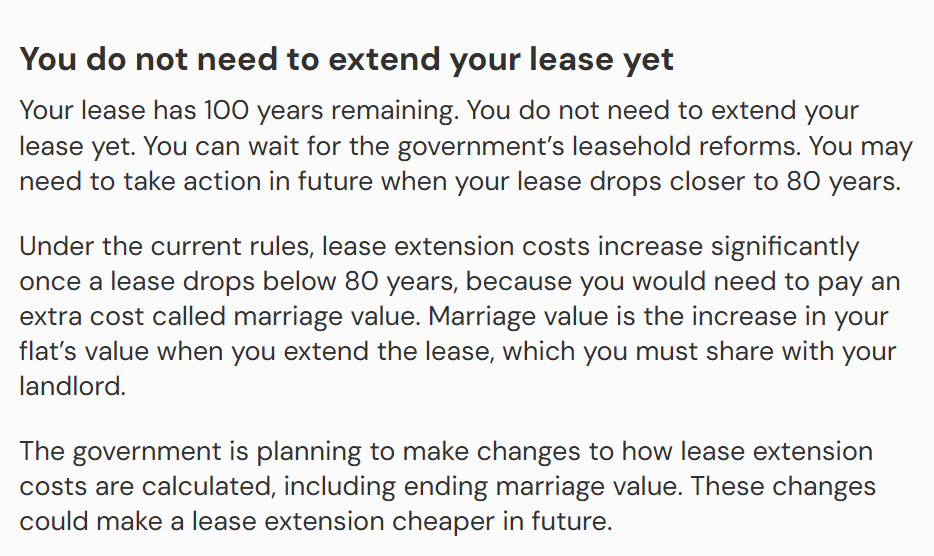
The government's reforms are intended to make lease extensions cheaper, but it's not yet clear how much leaseholders could save.One of the biggest changes is the abolition of 'marriage value'. This is an additional amount leaseholders currently have to pay when extending a lease with fewer than 80 years remaining, reflecting the increase in the property's value once the lease is extended.The government is still consulting on some of the other charges used to calculate the cost of a lease extension under the new system. The consultation closes on 23 September 2026, after which further legislation will be needed to set out how the new calculations will work.With new legislation in the pipeline, we asked Richard Hand, senior legal adviser at the Leasehold Advisory Service, whether leaseholders should wait before extending a lease.
He told Which?: 'Whether a leaseholder should extend now or wait for the reforms will depend on their lease and individual circumstances. If a lease already has 80 years or less remaining, there may be a benefit in waiting, as the reforms are intended to remove marriage value. However, leaseholders just above the 80-year threshold should seek specialist advice urgently, as there is a risk in waiting until the lease falls below 80 years under the current law.
'For those with more than 82 years remaining, there may be more scope to consider waiting, particularly if they're comfortably above the threshold and do not need to sell or remortgage. But there is no single lease length at which everyone should wait, and important details affecting the future cost of lease extensions are still to be finalised.'
Find out more:When will further leasehold reform happen?
In 2024, the Leasehold and Freehold Reform Act was passed. The Act applies to England and Wales.
In Scotland, there isn't the same issue with leasehold properties, as very few homes are sold with this type of ownership. Housing is devolved, so leasehold legislation differs in Northern Ireland.
Key provisions of the 2024 Act included:
However, only some of these measures are currently in force, as most require secondary legislation.
In January 2026, the Starmer government published draft legislation to further reform the sector by capping ground rents at £250 a year, banning leaseholds for most new flats and introducing a new process to make it easier for existing leaseholders to convert to commonhold.
Under commonhold, each homeowner within a building owns the freehold to their own property. The 'common' parts of the building are owned and managed by a commonhold association, made up of the building's homeowners rather than a third-party management company.
The earliest the draft bill will become law is 2027, and it's likely the bill will be implemented over a period of time.
Find out more:source https://www.which.co.uk/news/article/should-you-wait-for-cheaper-lease-extensions-aL84a6p9rINn