
Yet national reporting rates are still critically low and online scams continue to wreck lives, while the social media giants hosting these fraudsters face no penalties.
Here, we investigate the lasting mental and financial scars left by fraud and explain why the safety nets designed to protect victims are falling short.
Big Tech's responsibility vacuum
The gulf between where scams happen and where people report them speaks volumes.
Digital platforms also have the worst reporting systems: around half of victims found it difficult to report to apps and websites, while only one in five struggled to inform their banks.
One person told us: ‘I reported the fraudulent activity directly to Facebook using its built-in report button and Help Centre. Overall, the process was handled very poorly. It felt entirely automated, and I received nothing but generic, template responses. It needs to have real support agents to provide transparent updates on what actions are being taken against fraudsters.’
Find out more:The reporting gap
Lack of awareness is still the primary driver for ignoring official channels, alongside widespread scepticism that reporting achieves anything. Meanwhile, among those who didn’t even alert their banks, embarrassment and a belief that there was ‘no point’ were the main barriers.
When reporting to any platform or authority, around three in five encountered at least one problem, reinforcing the perception that there is no point and adding to the distress of being scammed.
These are the most common complaints found in our survey:
Every report that disappears into a black hole is a missed opportunity to stop criminals from targeting their next victim.
Find out more:The lasting impact of fraud
Recovering from fraud is about much more than reimbursement. More victims told us about a negative impact on their stress levels (63%) and mental health (54%) than on their finances (47%). Some said their physical health (32%) worsened.
Many described anxiety, strained relationships and feelings of shame or self-blame. Some were too embarrassed to tell friends and family what had happened, leaving them isolated when they most needed support.
Fraud can also undermine trust in services: a quarter said they have changed how they pay for goods online, and one in five stopped buying goods on social media.
The effect on your finances continues long after the initial loss. Victims may become reliant on borrowing from loved ones or taking out loans. And, if their identities were stolen to open fake accounts, they may scramble to fix their credit ratings.
Find out more:How fraud hits vulnerable people hardest
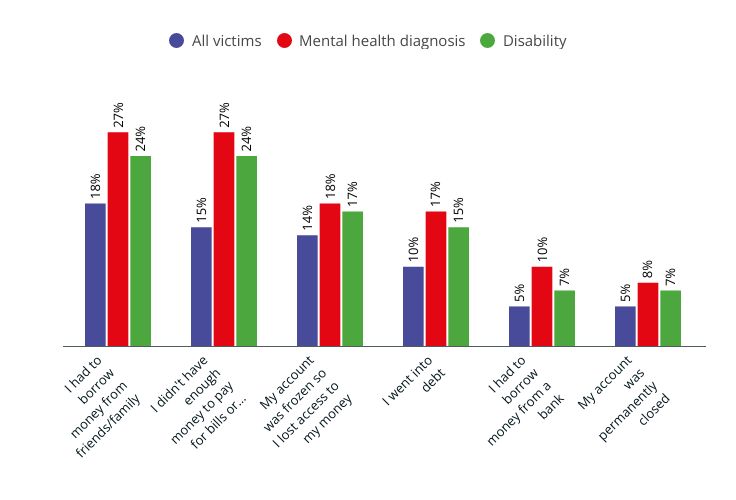
People with a diagnosed mental health condition at the time of being defrauded, as well as those with a longstanding physical or mental health condition, were much more likely to report being unable to afford everyday essentials, falling into debt and facing the permanent closure of accounts.
Basic standards are missing
The government has said its Fraud Victims Charter, due in 2027, will establish minimum national standards of care for scam victims, including response times and consistent advice on reimbursement and recovery. It also expects to use new data from the Report Fraud service to highlight fraud hotspots and help prevent victimisation.
Yet our findings demonstrate that fixing the UK’s fraud problem can’t be restricted to whether or not victims get their money back. Victims urgently need compassionate, sustained support to rebuild both their finances and their confidence.
Find out more: Which? surveyed 1,501 adults in the UK who had had money stolen via fraud in the past two years. Fieldwork was carried out online by Deltapoll on 1-12 June 2026, and the final data has been weighted to be representative of victims of fraud in the UK population (aged 18+).source https://www.which.co.uk/news/article/scammed-abandoned-and-forgotten-aSHFA9L81O8w